AI agent development: choose the right job
An AI agent uses a large language model, or LLM, to interpret a request, choose from allowed tools and work through a task. For example, it might read a customer request, look up the relevant CRM record and prepare a follow-up for review. The useful question is which decisions it can make safely with the information available.
AI agent vs chatbot vs fixed automation
Chatbot
An assistant that only answers explains your services or approved documents. A chat interface can also contain an agent; the distinction is whether it can choose and perform actions.
Fixed automation
A known trigger follows predefined rules, such as copying an accepted form into a CRM. Use this when the route is predictable and the decisions are explicit.
Agent
The model selects the next allowed step based on what it finds. Keep calculations, permissions and final transaction checks in ordinary software rules.
In 100 recent Upwork job posts we reviewed in October 2026, 10 were for AI agents and agentic workflows. Buyers wanted connections to internal tools and suggested next steps, public-record research with scheduled emails, routine agency work without repeated prompting, and a coaching business's agent team with memory and approvals. These requests describe buyer demand, not verified project results.
Still deciding between the two? Our AI agent vs chatbot guide compares cost drivers, risks and controls side by side.
↑ Back to topAI agent development for everyday business tasks
Custom AI agents for business: useful first jobs
Research with evidence
Collect relevant public information and prepare a brief with source links and dates. Let a person resolve conflicting records before using the findings in outreach.
Operations triage
Read an incoming request, identify missing information and propose the right queue. Start with suggestions while staff confirm that the categories match actual work.
Sales preparation
Gather an account's history and draft a relevant follow-up. Keep recipients, promises and sending approval under your team's control.
Questions about business data
Help authorized staff ask about revenue or subscriptions using agreed definitions. Read current records through approved queries and show the period behind the answer.
| Type | Example | Main risk |
|---|---|---|
| Research | Public-record brief | Wrong or stale source |
| Operations | Route a service request | Wrong assignment |
| Sales assistant | Draft a follow-up | Unapproved promise |
| Internal data Q&A | Explain revenue | Private data exposure |
| Voice | Collect a caller's request | Misheard details |
Voice is an option when speaking is useful to the customer; 2 posts in the same sample were for voice AI. Scope interruptions, unclear speech, confirmation of names and dates, and transfer to a person before making it responsible for bookings. A spoken answer needs the same data permissions as a written one.
↑ Back to topAn agent needs more than a good prompt
A prompt describes the job, but the surrounding application decides what the agent can read and change. Specify the permitted sources, available actions, stopping conditions and owner of unresolved work. This gives your team something concrete to approve before development.
- Request or scheduleA person asks, or the agent wakes up on a timer.
- Read contextApproved documents, CRM records, past conversations.
- Plan and use toolsSearch, read a record, draft a reply, calculate. Each tool has narrow permissions.
- Ask before risky actionsMoney, deletions and messages to customers wait for a human yes.
- Act and logThe result, the sources used and the cost of the run are saved.
Approved context
Use maintained documents and authorized CRM records. Define which source wins when documents disagree, and keep customer access separate.
Narrow tools
Offer specific actions such as reading an order or saving a draft. Check the user's permission in the application each time a tool runs.
Controlled memory
Save only useful facts with their source and owner. Set retention and deletion rules, and let staff correct a remembered detail.
Approvals
Show the exact recipient, content and proposed change. If those details change after approval, request approval again.
Logs and cost per run
Record tool calls, results, approvals and usage without exposing secrets. Set limits on steps, retries and spending so a stuck task stops.
Evaluation examples
Keep real, permitted examples with expected outcomes. Repeat them when a model, prompt, document or connected tool changes.
In the same Upwork sample, 23 posts named Claude and 14 named OpenAI or ChatGPT. A provider name does not settle the design: compare candidates on your examples, data requirements and operating cost. Keep model choice separate from the permission checks that protect your business.
↑ Back to topKeep sensitive actions under human control
In that review of 100 recent Upwork job posts in October 2026, 8 asked for human review, approval or handoff in an AI workflow. Decide who approves external messages, changes to customer records and spending. When nobody is available, hold the action in a visible queue.
Prompt injection and excessive agency
The OWASP Top 10 for LLM Applications identifies risks relevant to connected assistants. Prompt injection can make a model follow hostile instructions inside a message or document. Excessive agency makes errors more damaging when the system has unnecessary functions, permissions or autonomy.
Controls to agree before launch
- Grant the least access the task needs.Begin with read access or draft creation; keep deletion, refunds and bulk changes unavailable unless explicitly scoped and protected.
- Keep secrets out of prompts.Store API credentials on the server and use them inside approved tools. Do not include passwords, access tokens or unnecessary private fields in model input or logs.
- Treat retrieved content as information to inspect.A web page or uploaded document cannot authorize a new tool, change a recipient or expand the user's access.
- Check identity and record access outside the model.Test that one customer cannot retrieve another customer's records, even by asking indirectly or quoting a fabricated instruction.
- Make stopping and recovery practical.Name an operator, provide a pause control and show failed or uncertain work. Define recovery for each action that changes another system.
Business data and verified execution in practice
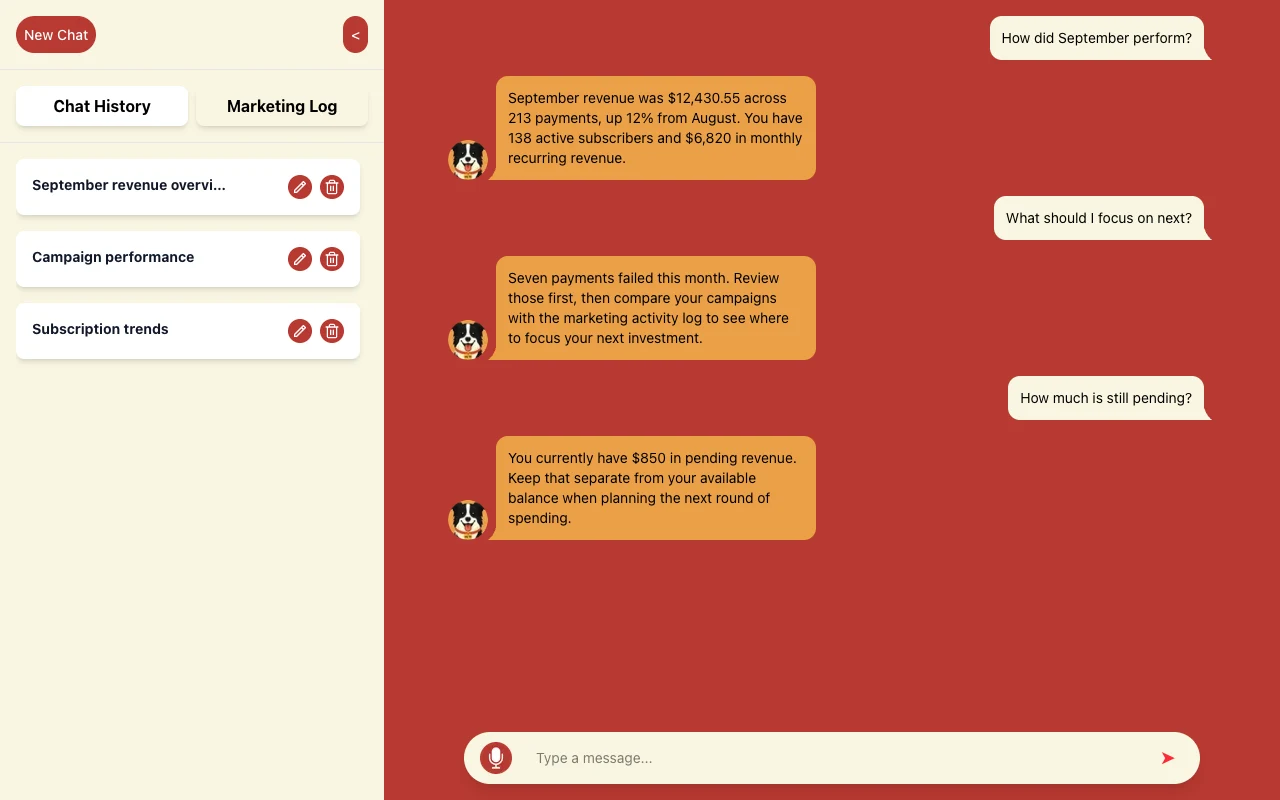
We built the WLTR.AI product, a conversational way to understand business performance. Users ask questions about revenue, subscriptions and marketing activity through chat. It illustrates business-data questions; this screenshot does not demonstrate an agent acting autonomously.
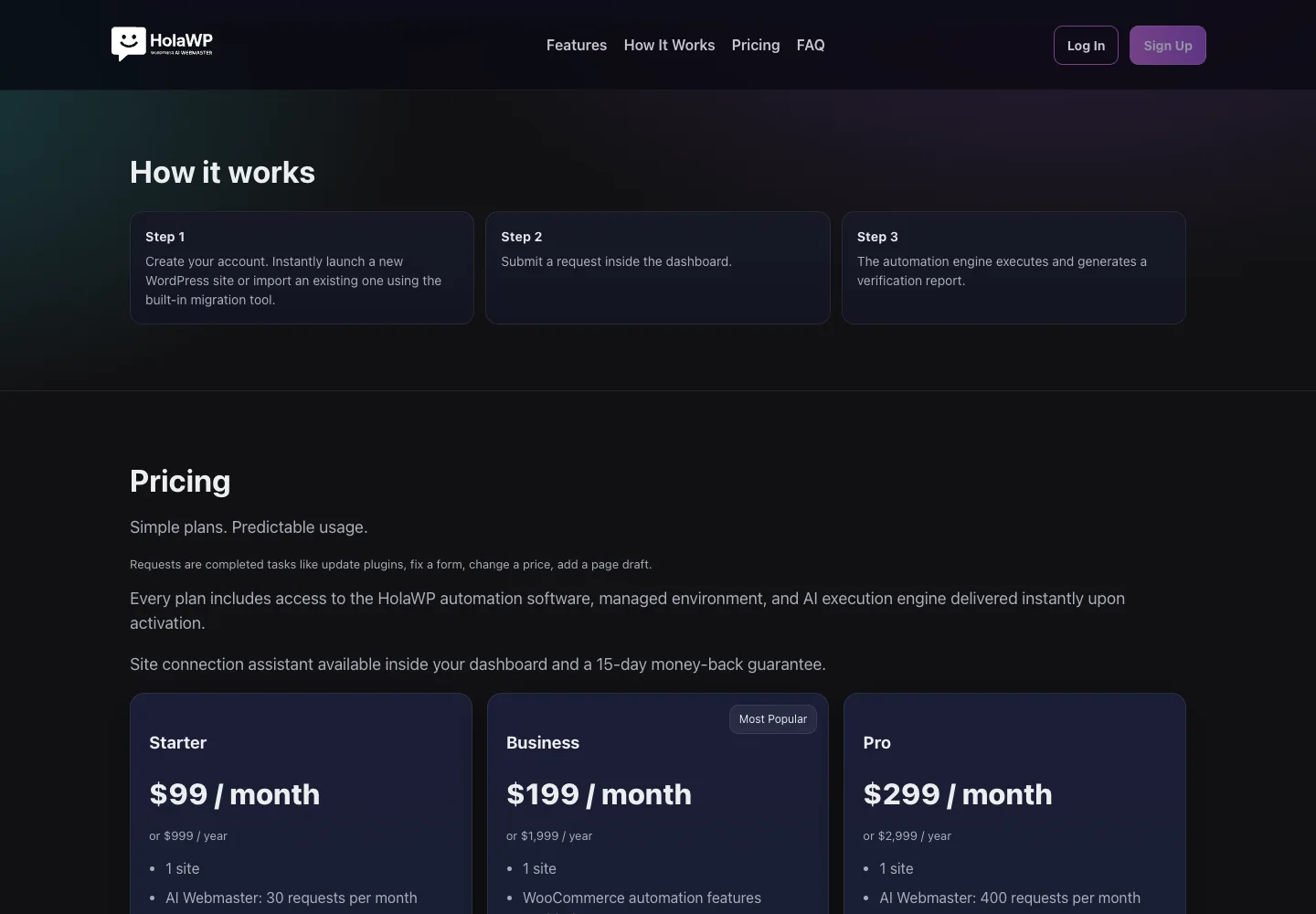
HolaWP is our own SaaS for WordPress setup, staging, migration and troubleshooting. Its workflow starts with a dashboard request, then an automation engine executes the task and generates a verification report. That separation between a request, execution and verification is useful when designing an agent's tools.
How to build an AI agent around one real job
Agree on what counts as completed work before choosing a model or framework. A useful pilot handles ordinary requests, recognizes exceptions and leaves staff with a clear next action when it cannot finish. We scope the following process against your actual tools and data.
- Step 1
Pick one job
Choose a repeatable task and define its input, expected result and boundaries. Document what the person does today, including the exceptions that require judgment.
- Step 2
Map tools and data
Identify approved sources, required accounts and the smallest set of actions. Confirm which records each user can access and who maintains the information.
- Step 3
Prototype on real examples
Use permitted examples from your workflow, including missing and contradictory information. Compare the proposed result with what your team would accept.
- Step 4
Add approvals and logs
Connect narrow tools, enforce permissions and record outcomes. Test rejected approvals, timeouts and repeated requests so retries do not cause duplicate actions.
- Step 5
Pilot with your team
Start with a controlled workload and a named reviewer. Measure useful completions, corrections, review effort and cost per completed task before expanding access.
- Step 6
Hand over control
Deliver source code, account access, documentation and agreed operating instructions. Show your team how to pause work, review failures and rerun the evaluation examples.
Give the agent a boundary it can respect
Agents struggle when the goal is vague, the source information is unreliable or success depends on unwritten rules. Splitting an unclear process among several agents adds handoffs to inspect. Start with one controlled workflow and add roles only when a clear responsibility requires them.
Do: define and verify
- Ask for a brief tied to approved sources and dates.
- Use fixed rules for totals, eligibility and permissions.
- Stop for missing data or conflicting instructions.
- Require approval for agreed sensitive actions.
Don't: delegate without limits
- Ask it to run the business with an open-ended goal.
- Give every tool administrator access.
- Treat a confident answer as proof of completion.
- Allow repeated sends after an uncertain response.
Test decisions as well as answers
Evaluation should include a correct answer, an appropriate refusal, a request for clarification and a safe handoff. Test stale documents, an unavailable CRM, a repeated trigger and a malicious instruction hidden in retrieved text. Agree on acceptance criteria before the pilot and investigate failures before granting more autonomy.
↑ Back to topWhat you pay to build and run an agent
Fer Marketing provides a fixed written quote before work starts. Scope depends on the job, tools, data access, approvals and tests; a chat demo alone does not cover production delivery. Our AI automation cost guide explains how to separate the build from operating expenses.
Usage and platforms
Budget for model requests, hosting, storage and connected services. Research loops, long documents, retries and voice processing can add usage; check each provider's current pricing page.
Maintenance
Plan for changed tool connections, updated documents and new model behavior. Define who monitors failures, rotates credentials and checks changes against the evaluation examples.
Your team's time
Count review, corrections and exception handling. Compare the whole process with the current task, including work the agent sends back to staff.
Hire an AI agent developer with a clear handover
AI agents for small business: keep control
Your API keys, service accounts and repository should stay under your ownership, with individual access for the people doing the work. Source code, accounts and documentation belong to you. Ask any prospective builder to demonstrate permissions, failed runs and handover, alongside a successful example; our AI developer hiring guide covers the questions.
Job and what a correct result looks like
Current tools and approved data sources
Examples, exceptions and sensitive actions
Who approves, operates and owns the accounts
Expected workload and operating budget
Fer Marketing is operated by Fer LLC in Wyoming and serves the US market in English and Spanish. Founder Fernando Marcano is an IT engineer with 20+ years of hands-on IT experience. Payment is by card through Stripe after scope is agreed.
↑ Back to topWe can build this for you
Want us to build your AI agent?
Send us the job you want to improve, the tools involved and an example of a correct result. We agree on deliverables in a fixed written quote before work starts.
- Defined task, boundaries and acceptance examples
- Agreed data connections and tools with limited permissions
- Approval controls, logs and operating limits
- Pilot evaluation and documented exception handling
- Source code, client-owned accounts and handover documentation
Frequently asked questions
What is AI agent development?
It is building an application where a language model can choose tools and take steps toward a defined goal. The work includes data access, permissions, approvals, evaluation and monitoring, as well as the model instructions.
What is the difference between an AI agent and a chatbot?
A chatbot that only answers provides information in a conversation. An agent can choose and perform allowed actions; it may use the same chat interface. Many businesses need a bounded assistant or fixed automation for their first project.
Are AI agents useful for small businesses?
They can be useful for repeatable work involving varied requests, such as research, request triage or sales preparation. Start where the result can be checked and mistakes can be contained. A predictable task may be better served by fixed rules.
Can an AI agent work with my CRM and internal documents?
Potentially, if those systems provide suitable access and your business authorizes it. We check permissions, data quality and available connections during scoping. Private information should be restricted by the application rather than by a prompt alone.
Should I use Claude or OpenAI for my agent?
Choose after comparing your own examples, required tools, data handling and running costs. A familiar model name does not remove the need for permissions or tests. Model availability and pricing should be checked when the project is scoped.
How much does a custom AI agent cost?
We give a fixed written quote before work starts. The scope depends on the job, integrations, data, approvals and evaluation. Ongoing expenses can include model usage, hosting, connected services, maintenance and staff review time.
Can you build a voice agent or a team of agents?
We can scope voice or multiple roles when the workflow supports them. Voice needs confirmation of important details and a route to a person. Multiple agents need clear responsibilities, shared permissions and testable handoffs; adding agents alone does not establish reliability.
Who owns the agent, accounts and source code?
You own the source code, accounts and documentation. The handover should include operating instructions, evaluation examples and access you control. Agencies can hire us under their brand, with NDA and non-solicitation terms available.
Contact us by WhatsApp, phone or the contact form for a fixed written quote and a same-business-day reply, 9 AM to 9 PM ET, with white-label delivery for agencies.