API integration services: start with one clear job
Start where your team repeatedly copies information and can describe the correct result. A paid order creating a CRM record is easier to verify than an instruction to connect everything. Name someone who can resolve exceptions during the pilot.
Orders and inventory
Route orders to the right partner and return fulfillment updates. Decide how cancellations, partial shipments and unavailable stock should behave before sending live orders.
Contacts and lead outcomes
Move qualified leads into the CRM and return their outcomes to reporting. Agree on matching rules so a returning customer does not become another contact.
Projects and documents
Create a document storage folder structure when a construction project is approved. Preserve the link between the project and its folders through renames and retries.
In 100 recent Upwork job posts we reviewed in October 2026, 12 were for API integrations and 5 were for marketing tracking and data plumbing. Buyers described bidirectional commerce and CRM sync, automatic project folders, order routing and unified messaging. These are observations from our sample, not estimates of the whole market.
↑ Back to topCustom API integration: match the business rules
An API is a controlled doorway through which software can request information or ask another system to do something. Access does not guarantee that every screen field or action is available. We check the actual accounts and supported operations before promising the connection.
| Integration type | Example | The hard part |
|---|---|---|
| Commerce + CRM | Orders to contacts | Matching and conflicts |
| Partner fulfillment | Route each order | Stock and cancellations |
| Project files | Create linked folders | Renames and duplicates |
| Messaging | Shared property inbox | Identity and permissions |
| Accounting | Invoices and payments | Refunds and totals |
| Ad reporting | Lead outcomes to ads | Attribution and repeats |
CRM integration for small business
For HubSpot integration services, define what creates a contact, which system owns each property and whether a changed email should update an existing person. Bidirectional sync needs field ownership, not a blanket instruction to keep both sides identical. Keep unsubscribe and suppression rules explicit.
Shopify order routing automation
Write routing rules by item, supplier and destination, including what happens when a partner rejects an order. Inventory needs an agreed freshness target and a fallback for stale data. Start with a controlled set of products before expanding to every dropship partner.
↑ Back to topWhat our API integration services include
You buy a working connection, not a script. Every engagement covers the parts that keep data correct after launch, and the written scope names each one with a fixed written quote.
- of 100 posts were API integration projects
- 12
- were marketing tracking and data plumbing
- 5
- asked to prevent duplicates or run exactly once
- 16
Fer Marketing review of 100 recent Upwork job posts, October 2026
Integration map
Which system owns each field, how records are matched, and what happens on create, update, cancel and delete. You approve it before any code is written.
Secure access
Authorization in your accounts with the narrowest permissions the job needs. Secrets live in your hosting or vault, never in code or chat.
Sync engine
Webhooks for speed, a scheduled reconcile for anything missed, idempotency keys so a retry never creates a second order or contact.
Alerts and logs
A log entry per run and an alert to a named person when something fails, with enough detail to fix it without guessing.
Tests with real cases
Duplicates, partial refunds, renamed records, empty fields and expired tokens tested in a sandbox or test mode before go live.
Handover
Source code in your repository, a runbook for recovery and replays, and a walkthrough for whoever maintains it next.
Systems we connect
| Category | Examples | Typical job |
|---|---|---|
| CRM | HubSpot, Salesforce, Pipedrive, HighLevel | Leads in, outcomes back |
| Payments | Stripe | Paid order starts fulfillment |
| Accounting | QuickBooks | Invoices and payments match |
| Ecommerce | Shopify, WooCommerce | Orders, stock, tracking |
| Messaging | WhatsApp Cloud API, Twilio, Slack | Notify, reply, hand off |
| Workspace | Google Calendar, Sheets, Drive | Bookings, folders, reports |
| Ad platforms | Google Ads, Meta | Offline conversions |
| Databases | PostgreSQL, Supabase | Your own source of truth |
Running on HighLevel? See GoHighLevel automation. Need the screens and users around the data too? See custom web app development.
↑ Back to topAPI integration services: prevent silent drift
A webhook is a notification a tool sends when something changes; polling means checking the tool on a schedule. Webhooks can provide prompt updates, while scheduled checks can find missed events. Choose the combination around the business's acceptable delay and the API's capabilities.
- 1. One source of truth per fieldDecide which system owns price, stock, status and contact data before writing code.
- 2. Webhooks plus a nightly checkChanges move in real time; a scheduled reconcile catches anything a webhook missed.
- 3. Idempotency keysThe same event processed twice still creates one order, one charge, one email.
- 4. Retries with backoffRate limits and timeouts retry later; events that keep failing go to a review queue.
- 5. Logs and alertsYou can see what synced, when, and why something did not.
Field ownership
The CRM might own the salesperson assignment while commerce owns the order total. Store the record identifiers from both systems and define how conflicts, deletions and older updates are handled.
Duplicate protection
An idempotency key identifies one intended action across repeated attempts. Keep a durable record of processed events so a repeated notification cannot quietly create another order or invoice.
Reconciliation
Compare the systems on a schedule, such as nightly, to find missing or mismatched records. Produce a repair queue and alert an owner instead of silently overwriting uncertain information.
In 100 recent Upwork job posts we reviewed in October 2026, 16 explicitly asked to prevent duplicates or make something happen exactly once. That is a business requirement to test, not a guarantee to make about every external API. A timeout can leave the outcome uncertain, so checking the destination may be safer than sending the action again.
Stripe documents idempotent requests for safely retrying supported operations with the same key. Its webhook guidance also covers duplicate deliveries and verifying signatures. Apply each provider's documented behavior, with your own processing record and recovery rules around it.
↑ Back to topKeep access secure and failures contained
OAuth lets you authorize an application without handing over your password. An access token is its permission credential; where supported, a refresh token obtains a replacement when access expires. Revoked access needs an alert and a reconnection route, not endless retries.
Do: keep control and a recovery trail
- Keep credentials in protected server-side storage.
- Assign a source of truth for each synced field.
- Log record IDs, outcomes and repair status.
- Separate each account's failures and retries.
Don't: depend on hidden assumptions
- Store access tokens in a shared spreadsheet.
- Sync both ways without field ownership.
- Run without logs or an alert recipient.
- Let one broken account stop the entire run.
Unattended access, rate limits and pagination
For an unattended job, use the provider's supported background authorization method, with only the permissions it needs. A temporary development token or an employee's interactive session is a poor operating plan. Document who can renew, revoke and restore access.
Rate limits cap how quickly requests can be made; use a queue and retry temporary failures with increasing pauses, called backoff. Pagination means results arrive in batches, so record progress through every batch. Isolate work by account so a revoked token affects that account while others continue.
↑ Back to topWhatsApp Cloud API integration with clear limits
WhatsApp Cloud API integration connects business messaging to your CRM, inbox or internal workflow through Meta's official API. A property management team, for example, may want WhatsApp and social messages in one inbox. Define which channels are included, who owns a conversation and how replies return to the right channel.
Templates, permissions and human handoff
Plan approved message templates for outbound notifications where required, recipient permission to receive them and the account permissions needed for the integration. Confirm current messaging rules, template requirements and account setup in Meta's WhatsApp Cloud API documentation. Platform approval and access are dependencies to resolve before launch.
Do not start by broadcasting to every contact. Pilot an agreed message type, confirm language and routing, and test opt-out handling and failed delivery. A channel connection does not itself resolve duplicate identities or authorize access to private booking details.
↑ Back to topConnected systems in our portfolio
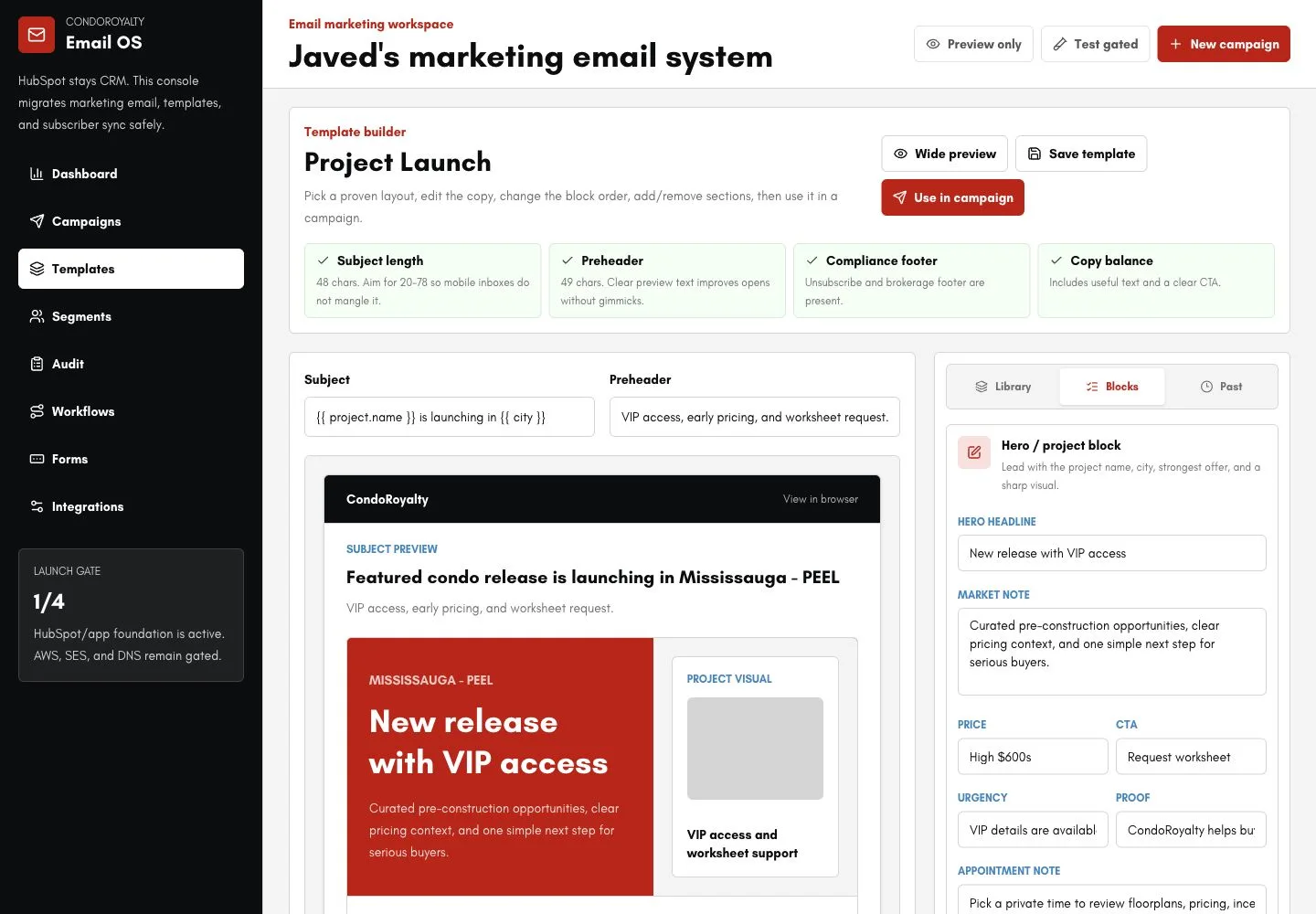
CondoRoyalty Email is a custom email platform that keeps HubSpot contacts synchronized and sends through Amazon SES. It includes gradual sending, suppression rules and campaign safeguards, alongside templates, a visual builder, scheduling and reporting. Contact synchronization and permission to send remain separate concerns.
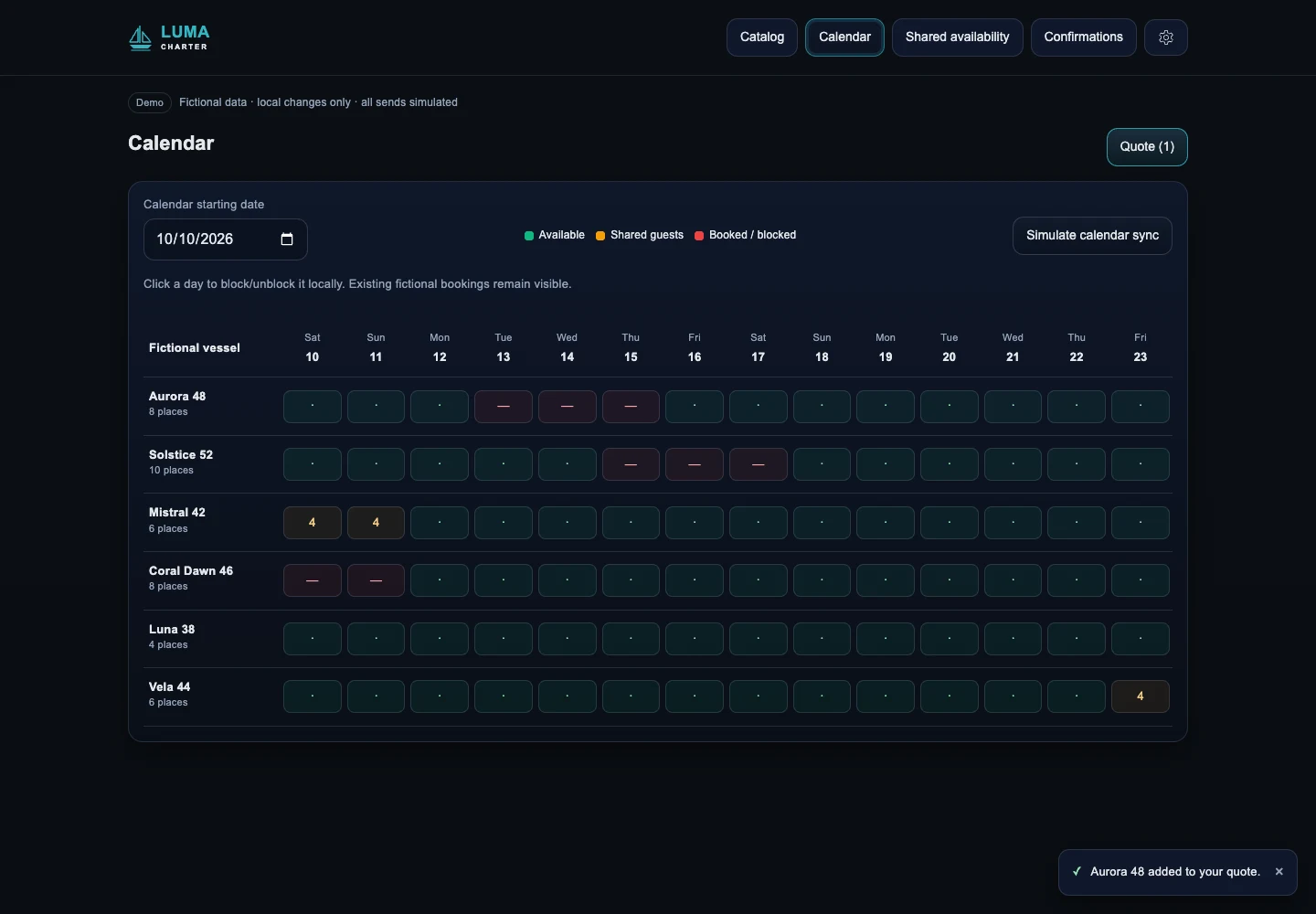
San Blas On Board brings boats with different owners and rules into a booking workflow with rule-based quotations, calendar coordination and guest check-in. It connects Google Calendar and Clientify CRM. Integration scope includes operating rules alongside the tools.
Questions to answer before connecting accounts
Follow a real record from origin to destination, with private information removed. Include an ordinary case and an exception. We can help settle unanswered rules before implementation.
Decisions that belong in the written scope
- Which system owns each field?Include contact details, order status, totals and consent. Define conflict, deletion and manual correction rules.
- How much data moves, and how quickly?Describe ordinary volumes, busy periods, existing records to import and the longest acceptable delay.
- Who owns the API accounts?Keep business ownership, billing and recovery access with you. Confirm required API access before relying on a connector.
- Who receives error alerts?Name a primary owner and a backup, with enough record information to locate the problem without publishing secrets.
- What happens on failure?Distinguish safe retries from cases needing review. Decide whether staff can continue manually and how those edits are reconciled.
- How will we accept the work?Include duplicate events, expired access, conflicting edits, missed updates and an account failing during a shared run.
Systems and business account owners:
Trigger and expected destination result:
Fields, matching rules and field owners:
Volume, busy periods and acceptable delay:
Known failures and alert recipient:
How we deliver your API integration
Delivery should prove that the workflow can recover as well as complete a clean example. We agree on observable acceptance checks before switching on live writes. Any ongoing monitoring or maintenance responsibility belongs in the scope too.
- Step 1
Map the workflow and confirm access
Review the source and destination with your process owner. Confirm supported operations, available permissions, field ownership, record matching and the systems your team will continue using.
- Step 2
Agree on scope and a fixed written quote
Document mappings, exceptions, historical imports, acceptance checks and operating responsibilities before work starts. Separate required functionality from later improvements so the pilot has a clear finish.
- Step 3
Build and test controlled cases
Use test accounts or approved test records. Exercise retries, repeated events, pagination, token expiry, conflicts and account isolation, with protected credentials and readable logs.
- Step 4
Pilot with a limited live workflow
Compare records across both systems and review exceptions with your team. Confirm the repair process and pause route before expanding to more accounts, products or actions.
- Step 5
Hand over and launch the agreed scope
Deliver source code, account access and documentation, including alerts, credential renewal and recovery procedures. Confirm who operates the connection and which changes require fresh testing.
Running costs, ownership and agency delivery
We quote integration work through a fixed written quote before any work starts. Cost depends on API access, mapping complexity, historical cleanup, volumes and failure handling. Use our AI automation cost guide to separate the initial build from operating expenses.
Platforms and hosting
Budget for existing software subscriptions, required API access, execution hosting and log storage. Check providers' current pricing pages against your expected usage before agreeing to an architecture.
Usage and retries
Track requests, message sends and workflow executions, including retries and historical imports. Set practical alerts and pause controls; add an AI usage budget only if the agreed workflow actually uses AI.
Maintenance and team time
Plan for API changes, access renewal and exception review. Assign responsibility for each task so a successful handover does not leave an unattended process without an owner.
For agencies: white-label
We offer white-label development for agencies, working under your brand with NDA and non-solicitation agreements available. Agree on client communication, account ownership and handover responsibilities. Source code, accounts and documentation belong to the client.
Fer Marketing is operated by Fer LLC in Wyoming, founded by Fernando Marcano, an IT engineer with 20+ years of hands-on IT experience. We serve the US market in English and Spanish. Payment is by card through Stripe after scope is agreed.
↑ Back to topWe can build this for you
Want us to connect your business systems?
Send us the tools and the workflow you want to improve. We will agree on deliverables and a fixed written quote before work starts.
- Field mappings, source-of-truth rules and account authorization
- Agreed API connections with duplicate protection and safe retries
- Error alerts, reconciliation and documented recovery procedures
- A controlled pilot and acceptance checks for critical failures
- Client-owned source code, accounts and handover documentation
Frequently asked questions
What do API integration services include?
The agreed scope can include account authorization, field mapping, record matching, webhooks or scheduled checks, duplicate protection, retries, alerts and reconciliation. Historical imports and ongoing maintenance should be specified separately, with acceptance checks and ownership documented before work starts.
Do I need custom API integration or an existing connector?
An existing connector can be enough when it supports your fields, volume and recovery rules. Custom work becomes useful for unusual mappings, multiple partner accounts, conflict handling or unsupported actions. We check the available API access before recommending the approach.
Can CRM integration keep both systems identical?
It can keep agreed data aligned, but not every field or action is available through every API. Define the source of truth per field, matching rules and acceptable delay. Scheduled reconciliation helps find missed updates and flags uncertain conflicts for review.
What should I ask a QuickBooks integration developer?
Ask how invoices, payments, refunds, taxes and rounding will map, who approves accounting rules and how totals will be checked. Request a demonstration of repeated submissions and partial failures. Your accounting owner should approve the mappings before live writes.
Can you build HubSpot integration services for our tools?
We can scope a HubSpot connection after checking account access, supported operations and your field rules. CondoRoyalty Email is a portfolio example that keeps HubSpot contacts synchronized with a custom email platform. Your integration still needs its own consent, suppression and exception rules.
What does WhatsApp Cloud API integration require?
It requires the appropriate Meta business assets, a business number, supported account access and permissions, plus message templates where required. Agree on recipient permission, conversation ownership and handoff rules. Confirm current requirements before making launch dependent on approval.
How long does an API integration take?
It depends on the number of systems, the quality of their APIs and how many edge cases the rules cover. After a short call and a look at the accounts, the written quote includes milestones and a timeline, plus what we need from you to keep it.
What happens when an API fails or sends an event twice?
The integration should isolate affected work, recognize repeated events and retry only when safe. Uncertain outcomes need a destination check or human review. Logs, alerts and scheduled reconciliation give the team a way to find and repair missed or mismatched records.
How much does an integration cost, and who owns it?
Every project receives a fixed written quote before work starts. Operating costs depend on subscriptions, hosting, usage and agreed maintenance. Source code, accounts and documentation belong to the client, and white-label delivery is available for agencies.
Contact us for a fixed written quote and a same-business-day reply, 9 AM to 9 PM ET, with white-label delivery available for agencies.