MVP development for startups: a narrow promise
An MVP is a minimum viable product: enough software to deliver a useful outcome and learn whether people want it. Choose a customer, a job and a reason to return, such as a client portal that collects documents and shows progress. Write down how you will recognize a completed job before adding dashboards or AI.
In 100 recent Upwork job posts we reviewed in October 2026, 23 were for SaaS or web app builds: 12 non-AI portals and MVPs, and 11 AI-powered products. Buyers asked for production-quality work rather than a quick prototype, separate customer workspaces and control of deployment accounts. These requests describe the responsibilities around the interface.
Do: include the essentials
- A complete path from signup to the promised outcome.
- Correct permissions and separate customer data.
- Payments and usage records if you charge at launch.
- An admin view, failure alerts and a recovery route.
Do not: expand before learning
- Build every audience, role and integration at once.
- Add AI to decisions that fixed rules already handle.
- Prioritize custom charts before a working core task.
- Postpone access controls until customers arrive.
Running an existing business that needs a portal or internal tool rather than a new product? See custom web app development.
↑ Back to topChoose a stack your product can justify
Custom web app development should follow the workflow, data and operational needs. Next.js, Supabase/Postgres, Stripe and an LLM API are a possible combination, not a requirement for every product. Confirm integrations, data handling and who will maintain the application before choosing.
| Part | Why use it | Watch out |
|---|---|---|
| Next.js | Web UI and server logic | Hosting and server access |
| Supabase/Postgres | Accounts and structured data | Workspace permissions |
| Stripe | Subscriptions or purchases | Repeated payment events |
| LLM API | Language or document tasks | Accuracy and usage cost |
Hiring a Next.js Supabase developer: ask about access
Supabase's row level security documentation explains database rules that control access to individual records. Ask for a demonstration that one customer cannot access another's data, including through exports and direct requests. Keep privileged credentials on the server and review file access separately.
AI SaaS development needs a bounded task
Choose a specific AI job, such as answering questions from approved business records, and define a useful result with examples. Keep permissions, balances and payment decisions in application rules. If the product must take actions across tools, our AI agent development service explains approvals and execution limits.
↑ Back to topMake payments and credits safe to repeat
A customer can double-click, refresh after paying or lose their connection while a task is processing. Design the product so retrying the same operation preserves the correct outcome. A disabled button helps the interface, but the server and database must enforce the rule.
Stripe webhooks must be idempotent
Idempotent means processing the same event again does not apply its business effect again. Stripe's webhook documentation covers signature verification and duplicate events; Stripe's idempotent request guide covers safely retrying API requests. Use both where appropriate, with durable records and database protections around credit changes.
Acceptance checks for a paid product
- A repeated event grants the purchase only once.Record the event and business operation so retries cannot grant credits or access twice. Check related events that describe the same purchase, too.
- Simultaneous requests cannot overspend credits.Reserve or deduct usage atomically, with a unique task reference. Define when a failed task releases a reservation or receives a refund.
- Account status follows verified payment records.Test failed renewals, cancellation and delayed notifications. A browser success page alone must not grant paid access.
SaaS MVP development: examples you can inspect
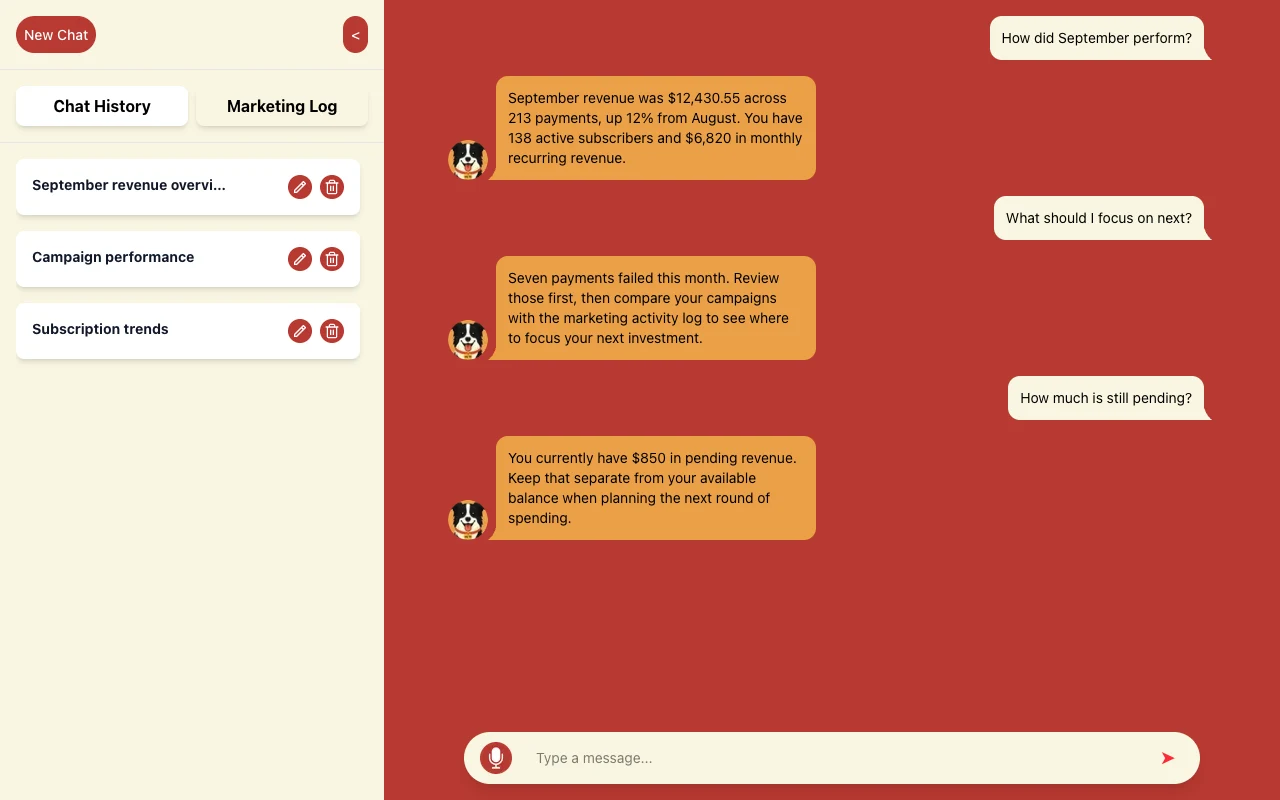
Our role in WLTR.AI was the product build. Users ask questions in a chat and get answers about revenue, subscriptions and marketing activity. Its stack includes Next.js, React, TypeScript, Supabase, Stripe and OpenAI.
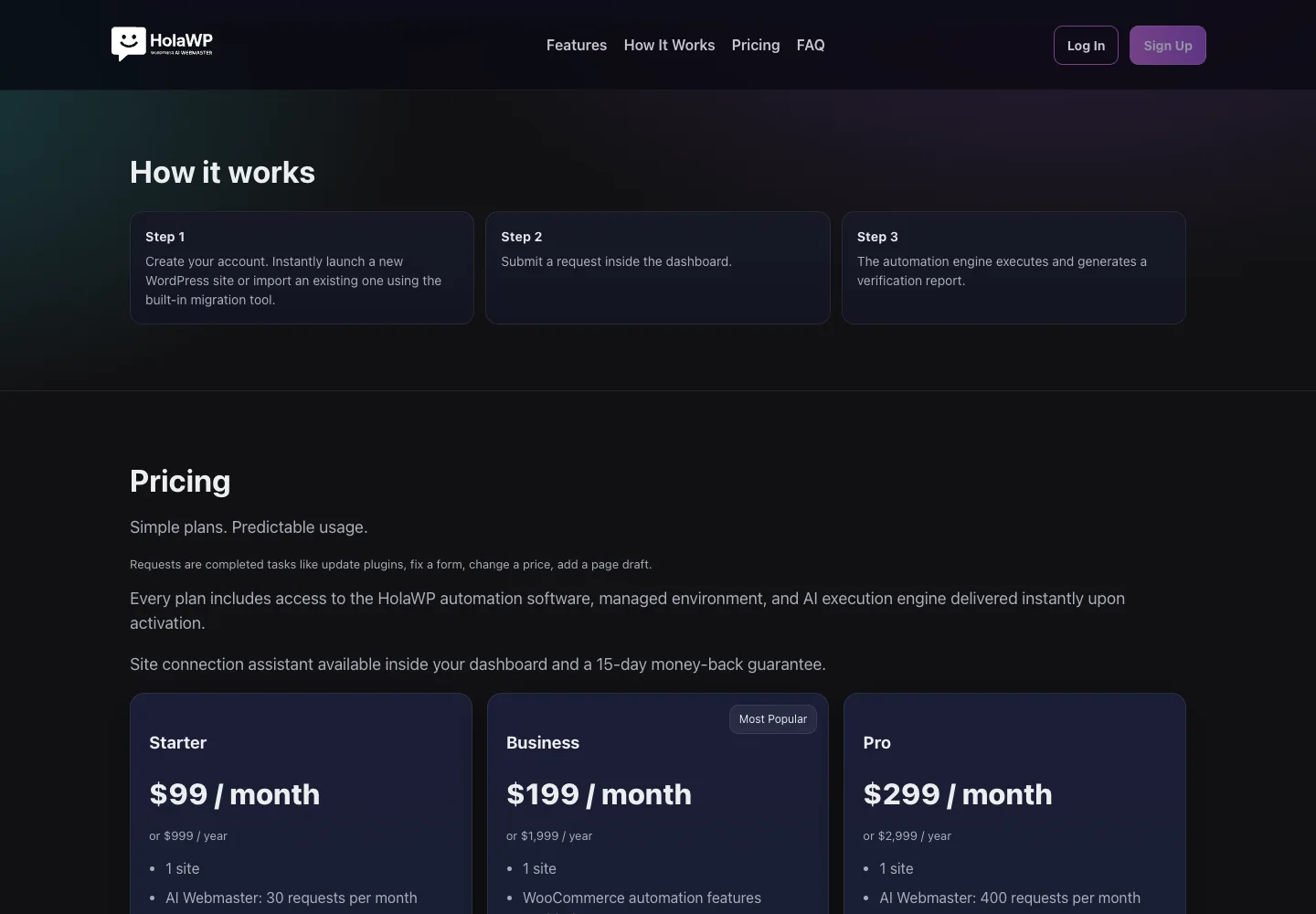
HolaWP is our own SaaS for one-click WordPress setup, staging, migration and troubleshooting, with server-side caching and AI-assisted diagnosis. Its workflow starts with a dashboard request, followed by execution through an automation engine and a verification report. It uses Next.js, React, Node.js, PostgreSQL, WordPress and AI integrations.
LatinoNews
LatinoNews is a Spanish-language news product built with JavaScript, Node.js, Express and Supabase. It is another example of product work using structured data.
San Blas On Board
San Blas On Board brings boats with different owners and rules into one booking workflow. Its stack includes Supabase, Google Calendar and Clientify, connecting quotations, calendars and guest check-in.
How we build a SaaS MVP around acceptance checks
The scope document gives the timeline after we understand the workflow, dependencies and review responsibilities. Access to existing systems, payment setup and feedback can affect delivery. Agree on what each phase must demonstrate before moving forward.
- ScopeCore user, core job, what is out. Written acceptance tests.
- Clickable prototypeScreens tested with real users before the backend exists.
- Core buildAccounts, data model, permissions, payments, the one workflow that matters.
- PilotA few real customers, error tracking on, weekly fixes.
- Launch and iterateOpen signups, watch usage and costs, build the next feature from data.
- Step 1
Define the first release
Document the customer, core workflow, roles, data, integrations and exclusions. Agree on acceptance examples and a fixed written quote before work starts.
- Step 2
Review a clickable prototype
Walk through the main task, empty screens and error states. Confirm what the customer sees and what staff must handle before committing to the full build.
- Step 3
Build the core in your accounts
Keep source code in your repository from day one and deployment in accounts you control. Build the agreed permissions, workflow, billing and operational tools.
- Step 4
Run a controlled pilot
Test complete journeys with approved sample data and selected users. Check customer isolation, repeated payments, failed tasks and recovery alongside normal use.
- Step 5
Launch and hand over
Prepare the agreed deployment, rollback instructions and operating documentation. Review pilot feedback and choose the next change based on customer use and support needs.
How much does it cost to build a SaaS MVP?
Fer Marketing provides a fixed written quote before work starts. Scope, roles, integrations, billing rules, data migration and AI behavior drive the work involved. Separate that project quote from hosting, database services, email, payment processing, model usage and maintenance.
- 1. Build (one time)Discovery, development, testing and handover.
- 2. Platform subscriptionsAutomation tool plan, hosting, database, vector store, phone or WhatsApp provider.
- 3. AI usageBilled per token or per minute by the model provider. Grows with volume.
- 4. Maintenance and changesAPIs change, prompts drift, your process evolves.
- 5. Your team's timeReviewing approvals and exceptions. Plan for it.
Estimate the cost of serving an active customer
Use an expected activity profile: tasks completed, documents processed, files stored and notifications sent. For AI, include unsuccessful attempts and retries when measuring consumption. Set usage limits, alerts and a defined pause when spending reaches an agreed ceiling.
Check each provider's current pricing page when preparing the operating estimate. Include support time, dependency updates and recovery work, and decide who monitors them. Our AI automation cost guide explains the recurring cost categories in more detail.
↑ Back to topTurn the proposal into a checkable delivery
Compare proposals against the same workflow and acceptance examples. A screen list does not establish whether permissions, billing and handover are included. Ask the builder to demonstrate a failed task and a repeated payment event, as well as a successful signup.
Before committing to a build
- Written scopeName the core journey, user roles, integrations and staff tools. State which data migration and setup tasks are included.
- Acceptance testsDescribe observable results for normal use, rejected access, payment retries and recovery. Agree on who reviews and approves delivery.
- Exclusions and changesList what can wait and how a new request changes scope, quote or timeline. Keep feature ideas separate from launch requirements.
- Ownership from the startRequire code in your repository and deployment in your accounts. Inventory credentials and provider subscriptions without putting secrets in documents.
- Handover and maintenanceInclude setup instructions, data structure notes, deployment and rollback steps, and support procedures. Agree separately on ongoing responsibilities.
Already have a Lovable, Replit or Bolt prototype?
Keep the useful product decisions and inspect the code before estimating the remaining work. Review authentication, customer data separation, exposed credentials, billing and deployment first. Our AI-generated code rescue service can help define what to preserve, repair or replace.
↑ Back to topOwn the product and know how to operate it
Source code, accounts and documentation belong to you. Give each collaborator individual access, keep business ownership of provider accounts and remove access when responsibilities change. Include an account inventory and an operating walkthrough in the handover.
A practical operating guide
Ask for instructions to review failed tasks, manage users, understand usage and restore service. Identify which changes your team can make and which need engineering review.
For agencies: white-label
We can work under your brand through our white-label development service. NDA and non-solicitation agreements are available; define client communication, approvals and handover in the scope.
Fer Marketing is operated by Fer LLC in Wyoming and serves the US market in English and Spanish. Founder Fernando Marcano is an IT engineer with 20+ years of hands-on IT experience. Payment is by card through Stripe after scope is agreed.
↑ Back to topWe can build this for you
Want us to build your SaaS MVP?
Tell us about your first release, who will use it and any existing prototype. We define the work in a fixed written quote before starting.
- Written scope, exclusions and acceptance checks
- Core workflow with agreed roles and customer data separation
- Agreed billing, integrations and usage controls
- Pilot checks, deployment and rollback instructions
- Source code, client-owned accounts and handover documentation
Frequently asked questions
What does SaaS MVP development include?
It includes the agreed core customer workflow and the supporting permissions, data storage, billing if needed, admin tools and operating documentation. The scope should define acceptance tests, exclusions and handover so you can judge the complete release.
How much does it cost to build a SaaS MVP?
We provide a fixed written quote after defining the first release. Roles, integrations, payments, migration and AI requirements affect scope. Hosting, subscriptions, model usage, maintenance and your team's time are separate operating costs.
Do you offer MVP development for startups?
Yes. We work with founders on a first release built around one customer workflow, with accounts, data protection, payments if needed and an operating plan. If you run an existing business and need a portal or internal tool instead, see custom web app development.
How long does it take to build an MVP?
The scope document gives the timeline after the workflow, dependencies and review responsibilities are clear. A narrow release and timely access to systems help make the schedule realistic. We do not promise a duration before reviewing the work.
Can you build an AI SaaS product?
Yes. We define the AI task, approved data, expected answers and usage limits alongside the application's ordinary permissions and billing. Evaluation should include wrong answers, missing information, provider failures and the cost of completed customer tasks.
Do I need Next.js and Supabase for my MVP?
They are one possible stack, not a requirement. Choose according to the product workflow, data, integrations, hosting and maintenance needs. Ask how customer records are isolated and how another developer would operate the application after handover.
Can you finish a prototype made with Lovable, Replit or Bolt?
We can review the existing application and define the remaining work. The review checks data access, credentials, payments, code structure and deployment before deciding what to preserve or repair. A working demo alone does not establish readiness for customers.
How do you stop credits being charged twice?
The design uses unique operation references, durable usage records and atomic database changes so concurrent requests and retries cannot apply the same debit twice. The acceptance checks must also cover repeated payment events and what happens when a task fails.
Who owns the code, and can agencies hire you?
You own the source code, accounts and documentation, with code in your repository from day one and deployment in accounts you control. Agencies can hire us under their brand, with NDA and non-solicitation agreements available.
Contact us by WhatsApp, phone or the form for a fixed written quote and a same-business-day reply, 9 AM to 9 PM ET, with white-label delivery for agencies.