SEO for electricians starts with local fit
When you run a crew of one to ten people, you may answer the phone between jobs. Choose the work you want more of before choosing search phrases: a panel replacement nearby and a small repair across the county create different schedules and margins.
Google identifies relevance, distance and prominence as local ranking factors. Google's local ranking guidance explains why results vary by searcher and location.
Relevance
How closely your business matches the search. Describe the electrical work you actually offer.
Distance
How far you are from the searcher. Listing another town as a service area does not move your business there.
Prominence
How well known your business is, including genuine reviews and links from other websites.
Benefits of SEO for electricians
Useful visibility can bring better informed inquiries: someone has already read that you install EV chargers, cover their neighborhood and explain the quote process. It can also save you from repeating basic answers on every call. Judge the work by qualified inquiries and booked jobs, alongside visibility, rather than treating every visit as a win.
↑ Back to topSet up an honest electrician business profile
Find and claim the existing Google listing before creating one. Keep ownership with your business, then give an agency its own access. For the full setup process, use our Google Business Profile checklist.
| Field | What to check |
|---|---|
| Primary category | Electrician, if it fits |
| Service area | Places you actually cover |
| Services | Real jobs you accept |
| Hours | When customers can reach you |
| Photos | Your crew and finished work |
| Reviews | Genuine feedback and replies |
Photograph completed work with permission, keeping customer addresses and private details out of view. Review the public profile after an edit: a wrong number or old opening time is a customer service problem even when the rest of the profile looks complete.
↑ Back to topBuild service pages that answer buying questions
Give each core service a useful page instead of putting every electrical job into one paragraph. The page should explain who the work is for, what you assess before quoting, where you offer it and how the customer starts. The electrician website design guide covers that page structure.
Panels and EV chargers
Separate panel upgrades from EV charger installation. Explain the site assessment, available capacity questions and what information helps prepare a quote.
Rewiring and lighting
Explain the homes or premises you serve, access needed and how you plan disruption. Show relevant completed work when you have permission.
Inspections and emergencies
Explain the inspections you perform. Publish an emergency page only if you genuinely offer that service, with accurate coverage and answering hours.
Local pages need local substance
A town page earns its place when it helps someone decide: your real coverage, a relevant completed job and practical scheduling details. Avoid pages that merely swap city names and funnel everyone to the same destination; Google's spam policies cover doorway abuse.
Do: explain real work
- Write separate pages for distinct services.
- Use local job details with permission.
- Answer permit and licensing questions.
- State actual emergency availability.
Don't: manufacture coverage
- Publish copied town pages in bulk.
- Invent an office or a local project.
- Promise permits without checking scope.
- Advertise 24/7 service you cannot staff.
Check your state licensing board and the relevant local permitting authority before publishing requirements. Explain who handles permits, what an estimate includes and which license or insurance details apply to your business, without implying the same rules cover every state.
Use Electrician structured data truthfully
Ask your web team to describe the business with the Schema.org Electrician type, a specific LocalBusiness type. Keep the name, phone, hours and service area consistent with visible information, then check for conflicting plugin output.
↑ Back to topAsk for honest reviews after real jobs
Make the request part of closing a completed job, using the same neutral invitation for customers regardless of how happy you expect them to be. Send the review link without writing the review for them. Keep complaints on a separate service follow-up path that never blocks access to the public review link.
Thank you for choosing our team.
Would you share your experience on Google?
Your honest feedback helps customers choose.
Review link: [your Google review link]
Reply calmly and protect the customer's privacy. A useful response acknowledges the concern and offers a direct conversation; it does not publish an address, invoice or argument about the homeowner. Assign replies to a named person so they do not sit unattended while everyone is on site.
↑ Back to topMake the next call easy on a phone
A homeowner comparing electricians should find your services, coverage and contact options without fighting a menu. Put a tap-to-call link near the top and after service details, with a short quote form for people who cannot call. Ask for contact details, location and the job, then collect more information during follow-up.
Test the call button on a real phone and submit the form through to your inbox. A button click is not a booked job, and a success message does not prove email arrived. For a small team, decide who handles missed calls and when quote requests get checked.
Mobile
Desktop
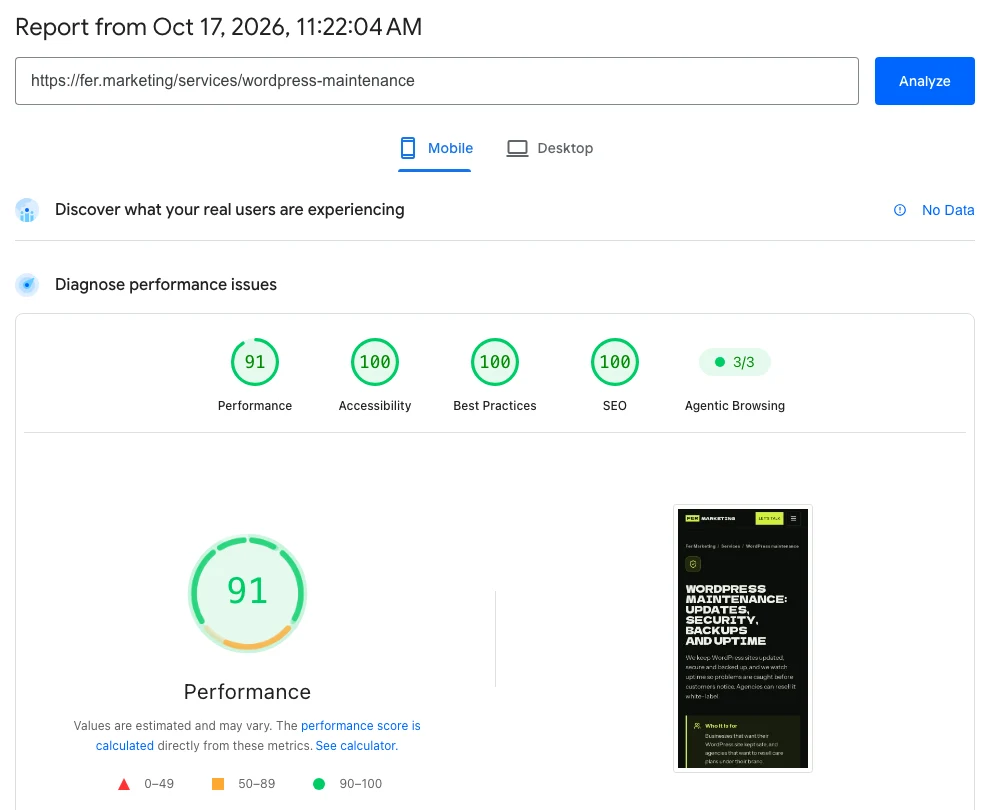
Our site uses Next.js, not WordPress; these are the same principles we apply on WordPress. Mobile PSI simulates a mid-range phone on slow 4G, so it is strict on purpose. These reports had no field data because traffic was still low, and a lab SEO score is not a ranking measurement.
↑ Back to topGold Wrench: local visibility connected to service
Gold Wrench is a mobile mechanic in Orlando, formerly marketed as 'mecánico a domicilio'. Like an electrician who travels to homes, it needs people to understand the services and coverage before getting in touch. Fernando has handled its local SEO and Google presence for years, and the business gets a steady flow of calls.
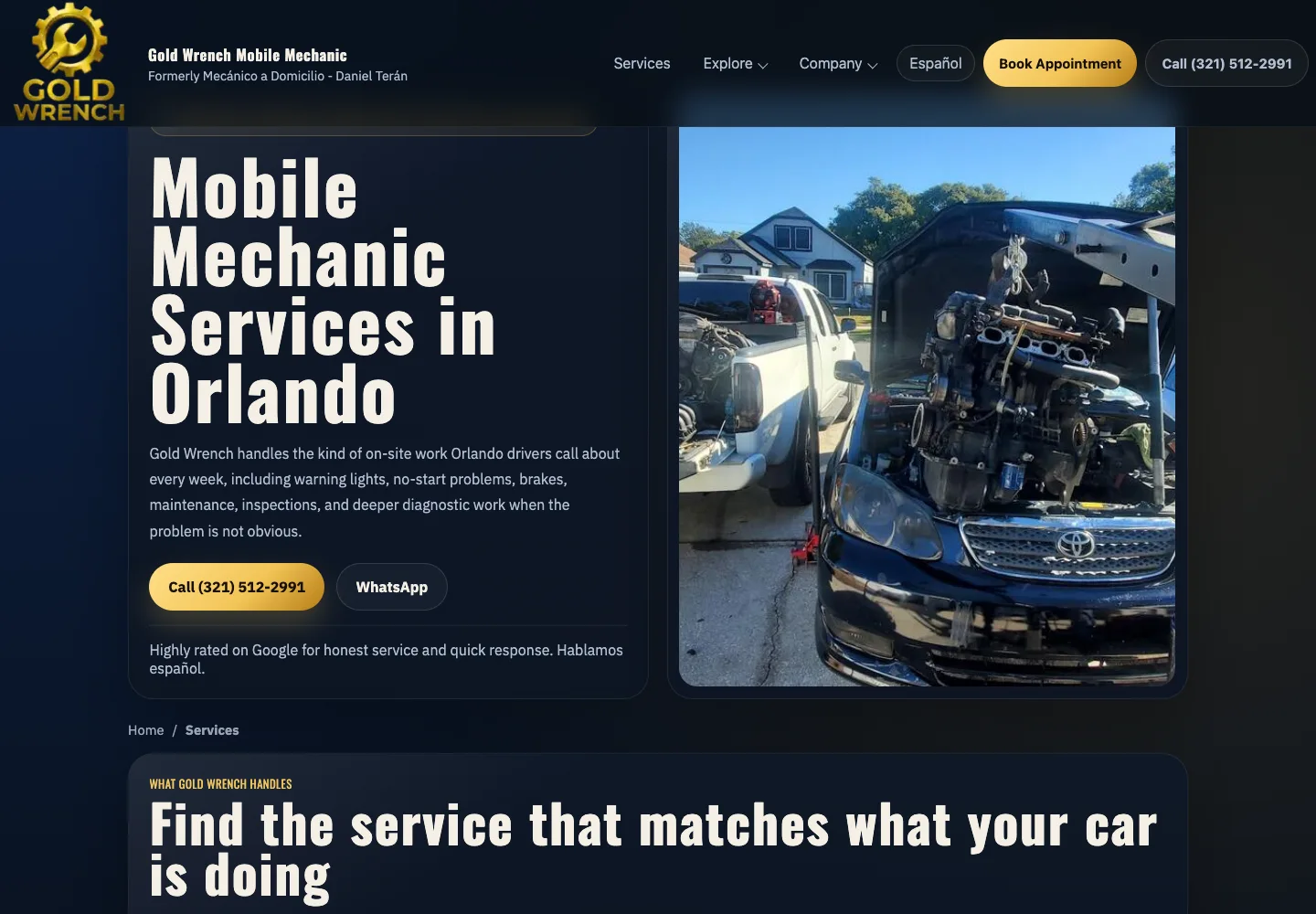
The website is custom built with HTML, CSS, JavaScript, PHP and Google Calendar, not WordPress, and includes a service catalog and bilingual booking journey. The relevant lesson is continuity: a customer can move from understanding a service to taking the next step. See the Gold Wrench project.
↑ Back to topSEO for electricians: your first 90 days
Use this as a work plan, not a deadline for rankings. An established business correcting a broken form has different priorities from a new company with no useful service pages. Finish the foundations before adding more towns or more content.
- Step 1
Record the starting position
List the services and locations you want, check profile ownership and save the current website issues. Review Search Console and profile performance where available, then start a simple inquiry log with service, area, source and outcome.
- Step 2
Fix facts and contact routes
Correct business details and availability, test calls and form delivery, and address urgent mobile problems. Have the owner approve service claims, license information and travel boundaries before publishing changes.
- Step 3
Publish the pages customers need
Prioritize core service pages, relevant local evidence and permit questions. Connect pages through clear navigation, review structured data and introduce a neutral review request after completed jobs.
- Step 4
Review inquiries and choose the next work
Compare comparable periods and record seasonality, capacity changes and any advertising separately. Discuss which inquiries became suitable jobs, which were outside scope and what customers still ask before approving the next set of changes.
| By day | Main work | Evidence |
|---|---|---|
| 30 | Profile + contact fixes | Facts approved; tests pass |
| 60 | Core service pages | Live pages; review request |
| 90 | Review + next priorities | Inquiry log; change record |
Count a call-button tap as an expression of interest, then separately record whether a conversation and a booking happened. If you missed the call while working, record that too. This helps distinguish a visibility problem from an answering or scheduling problem.
↑ Back to topA local SEO checklist you can hand to your team
Give each item an owner and keep evidence of completion. You do not need to understand every WordPress setting to ask for an approved page, a working contact test and a record of what changed.
Check the public result, not just the task list
- Confirm business ownership of key accounts.Keep access to the domain, hosting, Google profile and Search Console. Helpers use their own accounts rather than becoming the only people who can get in.
- Approve services, hours and coverage.Make sure the site reflects the jobs your crew takes now, including any limits on emergency calls or travel.
- Review the core service pages.Each page should answer a different buying need and explain assessment, quote expectations and the next step.
- Check license, insurance and permit wording.Verify applicable details with your state licensing board and local authority, and remove expired or unsupported claims.
- Review town pages for useful differences.Ask what local information each page adds. Consolidate pages that only repeat the same description.
- Test calls and quote delivery on a phone.Follow a real service-page journey, submit a labeled test and confirm someone receives it.
- Approve genuine project photos.Use work you can identify and have permission to show, without exposing the customer's private details.
- Keep review invitations neutral.Give customers the same opportunity to share honest feedback and assign responsibility for replies.
- Ask for a structured data review.Confirm that the business information is accurate and that multiple tools are not publishing contradictory details.
- Review inquiries alongside completed work.Keep a short record of suitable jobs, missed calls and requests outside your area so the next decision has context.
Hire an SEO agency or handle it yourself?
You can maintain accurate profile details, take job photos, request reviews and record inquiries yourself. Hiring help makes sense when the website needs technical work or this work keeps slipping behind paid jobs. SEO for electrician companies works best when the owner supplies business facts and the provider takes responsibility for agreed changes.
Keep owner decisions with you
Choose services, travel limits, answering hours and the jobs worth pursuing. Approve customer-facing claims and share the questions you hear on calls.
Give the web team clear work
Ask for service pages, mobile fixes, tested contact routes and accurate business markup. Require a change record you can understand.
Questions for any electrician SEO company
What will you change first, and why? Who owns the accounts and content if we stop working together? How do you separate Google profile interactions, website inquiries and actual bookings?
Will you show me the pages and links you create? How do you request reviews and handle service-area pages? What is included in the written price, what costs extra and how will we review progress without a ranking guarantee?
↑ Back to topWe can do this for you
Want us to connect local search with your WordPress site?
We can scope local SEO setup and WordPress fixes for your electrical business, from $250 with a fixed written quote. White-label delivery is available for agencies.
- Review profile details, service coverage and website consistency.
- Build or improve agreed service and useful local pages.
- Configure accurate Electrician markup and review its output.
- Fix mobile contact routes and test form delivery.
- Record changes and agree on the next review priorities.
Frequently asked questions
What is SEO for electricians?
It is the work of helping suitable local customers find and understand your electrical business through Google and your website. It includes accurate business details, useful service pages, genuine reviews and reliable ways to call or request a quote.
How long does electrician SEO take to work?
There is no fixed timetable or guaranteed position. Fixes to a phone link or form can help visitors as soon as they are live; changes in search visibility depend on the starting site, competition, location and Google's systems. Use the first 90 days to complete and review agreed work.
How much does SEO for an electrician cost?
The price depends on the profile, website, services and areas involved. Fer Marketing scopes local SEO setup and WordPress fixes as part of WordPress management, from $250 with a fixed written quote before any work. That starting price is not a promise to cover every ongoing SEO task.
Can I appear in Google Maps without a storefront?
An eligible electrician who visits customers can use a service-area profile. Hide the base address when customers do not visit it, and use your real business details. Do not create fake offices to target nearby towns.
Should I create a page for every city I serve?
Only create a separate page when it provides useful local information. A page with genuine coverage details and relevant work can help a customer choose; copying the same text with a different town name does not meet that goal.
Should emergency electrician service have its own page?
Yes, if emergency work is a real service you can deliver. Explain coverage, answering hours and the contact route honestly. Do not advertise round-the-clock availability when the owner cannot support it.
Can I buy reviews or ask only happy customers?
Do neither. Use a neutral invitation after genuine jobs and let customers describe their own experience. Avoid fake reviews, paid positive feedback and screening that keeps unhappy customers from the public review link.
Does WordPress need a special electrician SEO plugin?
No particular plugin is the strategy. Your team may use tools for metadata, structured data or performance, but the priorities are accurate information, helpful pages and a working contact journey. Review what is already installed before adding another tool.
Send your site and priority services for a fixed written quote from $250, with a same-business-day reply from 9 AM to 9 PM ET and white-label delivery available for agencies.