How we reviewed the Upwork job posts
We collected 100 posts from our Upwork search feeds: 70 from the most recent feed and 30 from best matches. We read titles, descriptions and skills, then assigned one primary cluster to each post by hand. The primary clusters therefore total 100, even when a project could fit several services.
For themes such as duplicate prevention and named tools, we searched the text and checked the matching excerpts by reading them. These theme counts overlap and must not be added together. We recorded what buyers wrote, without verifying their existing systems, hiring decisions or eventual results.
Fer Marketing sells AI automation and software services, so this is commercially interested research. We kept 11 out-of-scope posts in the denominator rather than removing them to make the relevant clusters look larger. The findings below describe the sample; the buying advice is our interpretation.
↑ Back to topWhat businesses hire AI developers for in 2026: counts
In 100 recent Upwork job posts we reviewed in October 2026, 23 were for SaaS or web app builds, 22 for integrations, tracking or scraping, and 17 for agents, chatbots or voice AI. Another 9 concerned rescuing, finishing or reviewing an existing application. Those are grouped primary clusters, rather than tool mentions.
- SaaS or web app builds
- 23
- Integrations, tracking or scraping
- 22
- Agents, chatbots or voice AI
- 17
- Explicit duplicate prevention requests
- 16
Fer Marketing review of 100 Upwork job posts, October 17, 2026
AI automation jobs 2026: tools versus outcomes
AI coding tools or app builders appeared in 24 posts; 23 named Claude and 14 named OpenAI or ChatGPT. These mentions do not measure tool adoption across businesses or prove that a particular tool produced the problem. For a buyer, the useful question is whether the developer can explain and maintain the delivered work.
↑ Back to topThe project categories behind the requests
Fer Marketing review of 100 Upwork job posts, October 17, 2026
The software categories split into non-AI SaaS MVP development and AI-powered products, with custom web applications covering portals and business-specific workflows. The agent group spans AI agent development, support chatbots and voice interfaces. Existing-app reviews belong with AI-generated code repair, not automatically with a complete rebuild.
Connecting systems, preserving marketing attribution and extracting data grouped into 22 posts. Start with API integration services when systems need to agree, or workflow automation when a business process needs coordinated actions. The 14 WordPress and WooCommerce posts belong with WordPress web design; the 4 technical SEO and AI search posts relate to appearing in ChatGPT.
Named automation platforms are overlapping signals
Across 8 posts, the text named n8n, Make or Zapier. Tool-specific checks including skills found n8n in 7, Zapier in 5 and Make in 3; those counts overlap and use a broader field check, so they are not a breakdown of 8. Our n8n, Make and Zapier comparison explains the buying decision; 3 posts mentioned GoHighLevel, and 2 were WhatsApp Cloud API work.
↑ Back to topPosted budgets and the cost of keeping work running
The sample contained 72 hourly posts and 28 fixed-price posts. Fixed budgets ran from $100 to $11,000, with a median of $1,850. Among 51 hourly posts with a range, the median range was $25 to $47 per hour; 21 hourly posts gave no rate.
| Cluster | Fixed budgets seen | Hourly median range |
|---|---|---|
| WordPress | $300; $700; $1k; $1.5k | $20 to $40 |
| SaaS / web MVP | $1.5k; $2k; $2.5k; $5k; $11k | $20 to $90 |
| API integrations | $750; $2.5k; $5k | $25 to $50 |
| AI SaaS | $2.5k; $7k; $7.5k; $10k | $22.50 to $52.50 |
| Out of scope | Not reported | Not reported |
| AI agents | $1k; $1k; $2k; $2.75k; $6k | $15 to $40 |
| App rescue | None fixed | $25 to $47 |
| Chatbots | $100 | $15 to $35 |
| Tracking | None fixed | $25 to $50 |
| Scraping | $700; $1.7k | $17.50 to $37.50 |
| SEO / AI search | $500 | $30 to $65 |
| Voice AI | $1k | Not reported |
- 1. Build (one time)Discovery, development, testing and handover.
- 2. Platform subscriptionsAutomation tool plan, hosting, database, vector store, phone or WhatsApp provider.
- 3. AI usageBilled per token or per minute by the model provider. Grows with volume.
- 4. Maintenance and changesAPIs change, prompts drift, your process evolves.
- 5. Your team's timeReviewing approvals and exceptions. Plan for it.
Ask for a running-cost estimate tied to expected activity, with spending alerts and a way to pause work. Specify who pays for accounts, checks failures and updates integrations when connected tools change. Our AI automation cost guide explains those decisions without turning posted budgets into a price list.
↑ Back to topSix recurring problems behind the briefs
The recurring pain points below are qualitative themes from the review, not ranked frequencies. Quoted fragments are buyers' wording from the sample, without names. They explain why a working demonstration is only part of the buying decision.
Manual copying between tools
Buyers wanted records and follow-ups to move without repeated copying. Start with a stable task and clear input fields; automating an unresolved process can spread its mistakes faster.
An action runs twice, or disappears
Duplicate prevention appeared explicitly in 16 posts. Ask what happens when an event repeats, a person clicks again or a connection fails after the action was already completed.
A prototype cannot be trusted
One buyer asked for 'production-quality work, not a quick prototype'; another described 'AI slop: duplication, overcomplicated code, and bugs that keep turning up'. Review money, permissions and customer-facing paths before extending features.
Cost and dependency are unclear
A buyer wanted a system to 'run while I sleep, without me prompting it all the time'. Agree on operating limits, failure alerts, documentation and account ownership before approving unattended work.
AI needs a person at the boundary
Human review, approval or handoff appeared in 8 posts. Define which actions can happen automatically, which require permission and who receives a request the system cannot safely finish.
Records must match across systems
The phrase 'keeping it in parity' captures a practical integration concern. Identify the authoritative system for each field and how discrepancies will be found and corrected.
What buyers test before hiring an AI developer
Screening questions appeared in 32 posts, with 111 questions in total. Of those posts, 26 asked for proof of past work, 16 posed technical scenarios, 5 asked how AI-generated code is reviewed, 9 asked about testing or rollback and 6 asked about availability. These categories overlap; their denominator is the 32 posts with questions.
| Scenario | What it tests | Ask to see |
|---|---|---|
| Stripe webhook arrives twice | Duplicate protection | One recorded outcome |
| Two Generate clicks together | Concurrent requests | One authorized job |
| 1-cent balance after full payment | Rounding rules | Reconciled payment test |
| gclid lost before the CRM | Attribution continuity | Tracked test lead |
| One ad account fails | Failure isolation | Other accounts finish |
You do not need to judge code line by line. Ask the developer to explain the failure case in plain language, demonstrate the agreed result and show where staff would find the record. For paid work, clarify exactly what the developer personally delivered in a portfolio example.
↑ Back to topWhat businesses hire AI developers for in 2026: briefs
What to put in an AI project brief
Describe a complete business transaction and what counts as finished. If the task is to answer an order question, specify the approved information, identity checks, permitted actions and escalation route. Avoid assigning unlimited responsibility with a sentence such as 'automate our support'.
Do: give a strong brief
- Look up an order after verifying the customer.
- Answer from approved order and policy sources.
- Draft refund requests for staff approval.
- Record actions and pass unresolved cases to support.
Don't: leave a vague brief
- Build an autonomous AI employee.
- Connect everything and make it smart.
- Let the AI decide refunds and permissions.
- We will work out success after launch.
Include these details before requesting proposals
- Current process and desired outcomeShow a typical request and an awkward exception. Explain what your team does today and what you want to stop doing manually.
- Tools, data and ownershipName connected systems, access constraints and the source of truth for key fields. Request client-owned accounts, source code and documentation.
- Boundaries and acceptance checksList actions that need approval and tests for repeats, missing data and unavailable tools. Define who accepts the completed work.
- Operating responsibilityAsk for expected subscriptions and usage costs, alerts, a pause control and a named person responsible for exceptions.
- Delivery scope and handoverSeparate necessary launch features from later ideas. Ask for a written scope, verification evidence and instructions your team can follow.
How to scope your project with this report
Use the report as a discussion aid, not a specification copied from another buyer. A system that handles payments has different acceptance requirements from one that drafts internal notes. Work through the business decision before choosing an agent, workflow platform or custom application.
- Step 1
Choose the business outcome
Pick a repeated task with known inputs and an observable result. Document the current process and exceptions with the person who actually handles the work.
- Step 2
Find the closest project category
Use the clusters to distinguish a new product, a connected workflow and an existing-app repair. A familiar category helps you request relevant examples without prescribing unnecessary technology.
- Step 3
Write the acceptance cases
Choose normal, repeated and failed requests. Agree on what staff should see and which actions need approval before any production access is granted.
- Step 4
Compare complete proposals
Review scope, evidence, operating costs, ownership and handover together. Ask for a fixed written quote based on your requirements, rather than matching a posted budget from this sample.
Evidence to request, including white-label delivery
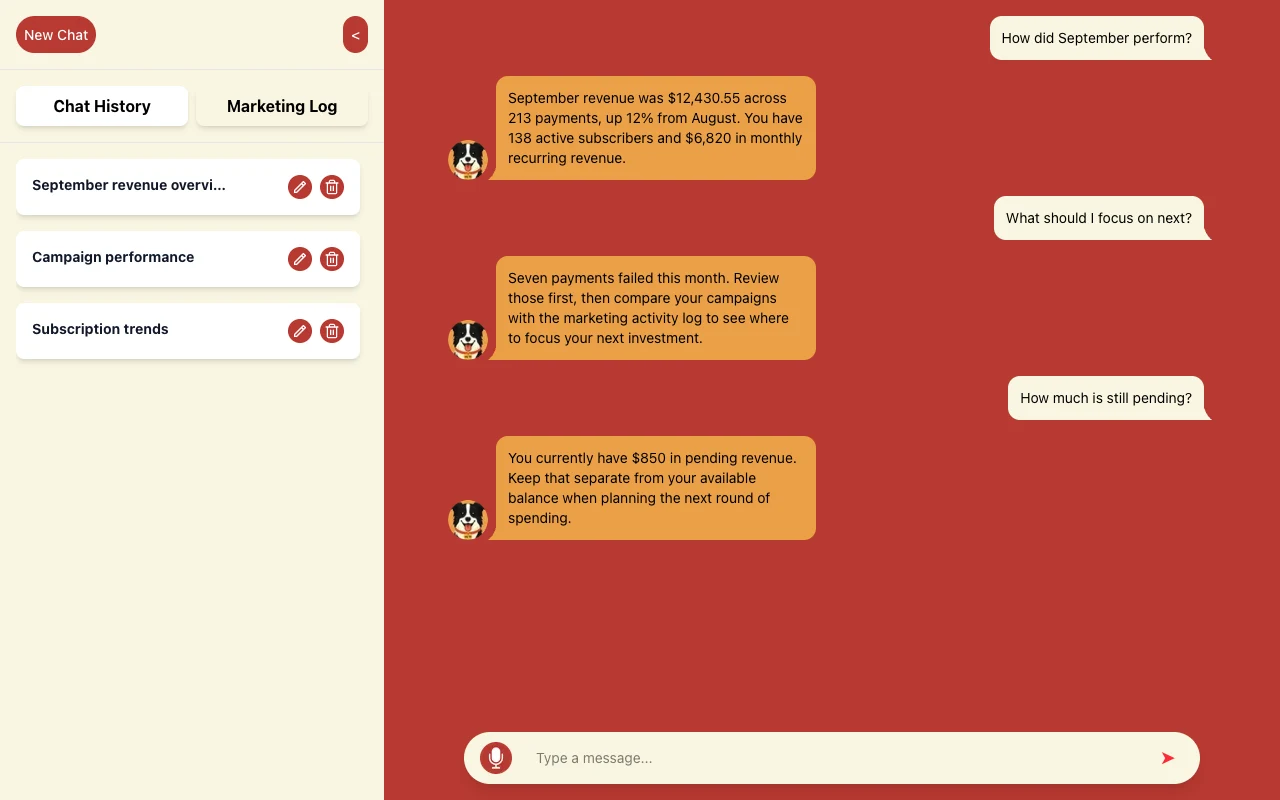
A portfolio should help you inspect a relevant workflow. In WLTR.AI, our role was the product build: users ask business questions in chat and receive answers about revenue, subscriptions and marketing activity. This is our own work, separate from the anonymized Upwork sample.
For agencies: white-label
Our white-label development service works under your brand, with NDA and non-solicitation available. Agree on client communication, approval responsibilities and who receives alerts after handover.
Keep control of the result
Source code, accounts and documentation belong to the client. Fer Marketing is operated by Fer LLC (Wyoming); founder Fernando Marcano is an IT engineer with 20+ years of hands-on IT experience.
Send your brief through our contact form, WhatsApp or phone. We reply the same business day, 9 AM to 9 PM ET, in English or Spanish, and provide a fixed written quote before work starts. Payment is by card through Stripe after the scope is agreed.
↑ Back to topWe can build this for you
Want us to turn your brief into working software?
We scope and build automations, AI tools and business applications around an agreed outcome. You receive a fixed written quote before work starts.
- Written scope, workflow boundaries and acceptance cases
- Agreed integrations, permissions and approval controls
- Verification of critical paths and failure handling
- Client-owned source code, accounts and documentation
- Handover instructions and agreed operating responsibilities
Frequently asked questions
What does this Upwork AI jobs analysis actually measure?
It records requests in 100 job posts collected on October 17, 2026. It measures the content of that sample, not completed hires, business results, total demand or growth in the AI market.
What businesses hire AI developers for in 2026?
In our sample, grouped requests included software products, integrations and data workflows, agents, chatbots, voice AI and existing-app repairs. The counts describe our Upwork search feeds on one day and cannot establish a market-wide ranking.
Are the posted budgets realistic prices for my project?
They are buyer-stated budgets, not final contract prices or Fer Marketing prices. Compare written scopes, acceptance checks, operating costs and ownership before using any budget as a reference.
Why do the named-tool counts overlap?
A post can mention several tools and concerns while receiving only one primary cluster. Tool-specific checks also included skills, so they use a broader field check than the combined text-only automation-platform count.
What should I put in an AI project brief?
Include the current process, desired result, connected systems, data sources, approval boundaries, failure cases, acceptance tests and handover requirements. Ask who controls accounts and who handles exceptions after launch.
How can I assess a developer without being technical?
Request a relevant demonstration, ask what the developer personally built and discuss a failure case from your own business. A clear explanation of duplicate prevention, testing and recovery is more useful than a list of tools.
Does mentioning an AI coding tool mean an application needs repair?
No. Tool mentions and rescue work were counted separately. Evaluate the application through its behavior, critical-path checks, permissions, maintainability and documentation rather than judging it by the tool used to write it.
Can an agency use this report and hire you in white-label?
Yes. Cite Fer Marketing, the report date and URL, and preserve the methodology caveats when using findings. We also deliver under an agency's brand, with NDA and non-solicitation available and a fixed written quote before work.
Send your brief for a fixed written quote and a same-business-day reply, 9 AM to 9 PM ET, with white-label delivery available for agencies.